Chelsea Depot Association
Quaint & Elegant, The Perfect Historic Location for Parties, Weddings, Memorials, Receptions, Showers and More!
History of the Chelsea Train Depot
During the influx of settlers in the early 1800’s, Darius and Nathan Pierce, from Ontario County, New York, Elisha and James Congdon from Chelsea, Massachusetts, and settlers from Vermont moved to the area now known as the “City of Chelsea”.
The Pierce brothers bought 640 acres located at the present day Main Street and Old U-12. This area was soon established as a hamlet called “Pierceville”. Further to the south was a group from Vermont who took up an area, calling it “Sylvan Center”, known today as M-52 and Jerusalem Rd.
The Congdon brothers had taken up land on the hill that was to figure prominently in the history of Chelsea. The prospects for crops were poor. The only advantage was a wagon trail cutting through a third of their land. After some time Nathan split from Darius, and settled an area near today’s M-52 and Sibley Rd.. By 1834, this Washtenaw County community was renamed “Kedron” after a river in Jerusalem.
In 1840 the Michigan Central Railroad began to build westward from Detroit to Marshall. By 1844 they had built as far west as Kedron. Elisha, owning the land south on the hill with the wagon trail and railroad crossing didn’t care for the name Kedron. On July 20, 1844, Darius Pierce wrote to U.S. Senator Alpheus Phelps of Ann Arbor and asked if the name of the settlement Kedron could be changed to Chelsea, after his hometown. Phelps wrote to Washington, and they replied that if it were satisfactory to the five families who lived there, the name could be changed. Shortly “Kendron” became “Chelsea”.
With the connection of the wagon trail (M-52) and the railroad, business from “Pierceville” and “Sylvan Center” started to move up to Congdon hill, bringing Barbers, Blacksmiths, General Stores, and Hotels. The hamlet of Chelsea was transformed.
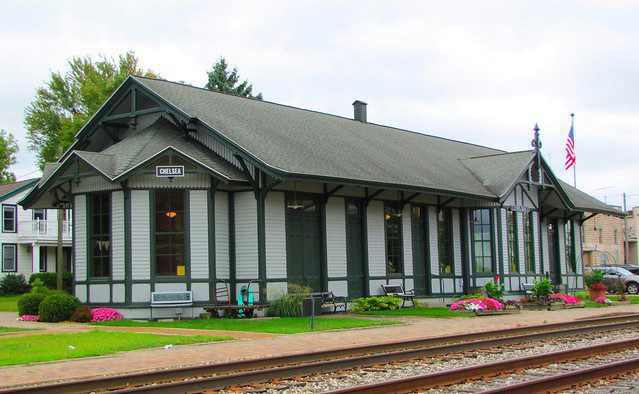
In 1848 they offered the Michigan Central Railroad a free site on which to build a station. The first and succeeding structures were freight stations. First shipment sent on May 2, 1850, was a barrel of eggs weighing 130 pounds. For a time more wool was shipped from Chelsea than from any other place in the state. Grain, apple, stock, and meat shipments were also large. In 1880 the Michigan Central established Chelsea as a passenger service point. The depot was built with two waiting rooms – the east for women and children, the west for men. Chelsea was chosen by the Michigan Central Railroad for an experiment in upgrading the appearance of rural stations. Mason and Rice of Detroit were commissioned as the new station’s architect. Their design was Victorian, characterized by numerous gables and gingerbread embellishments. This depot served patrons of the Michigan Central until 1975 when the company was taken over by Amtrak. In 1981, Amtrak discontinued service to Chelsea and closed the station. Fearing damage from prolonged neglect, area citizens formed the Chelsea Depot Association in 1985 to restore the building. The group purchased the depot that year, and restoration began in 1986.